Latifa Alajlan on Space, Abstraction, and Her Solo Exhibition at Franklin Parrasch Gallery
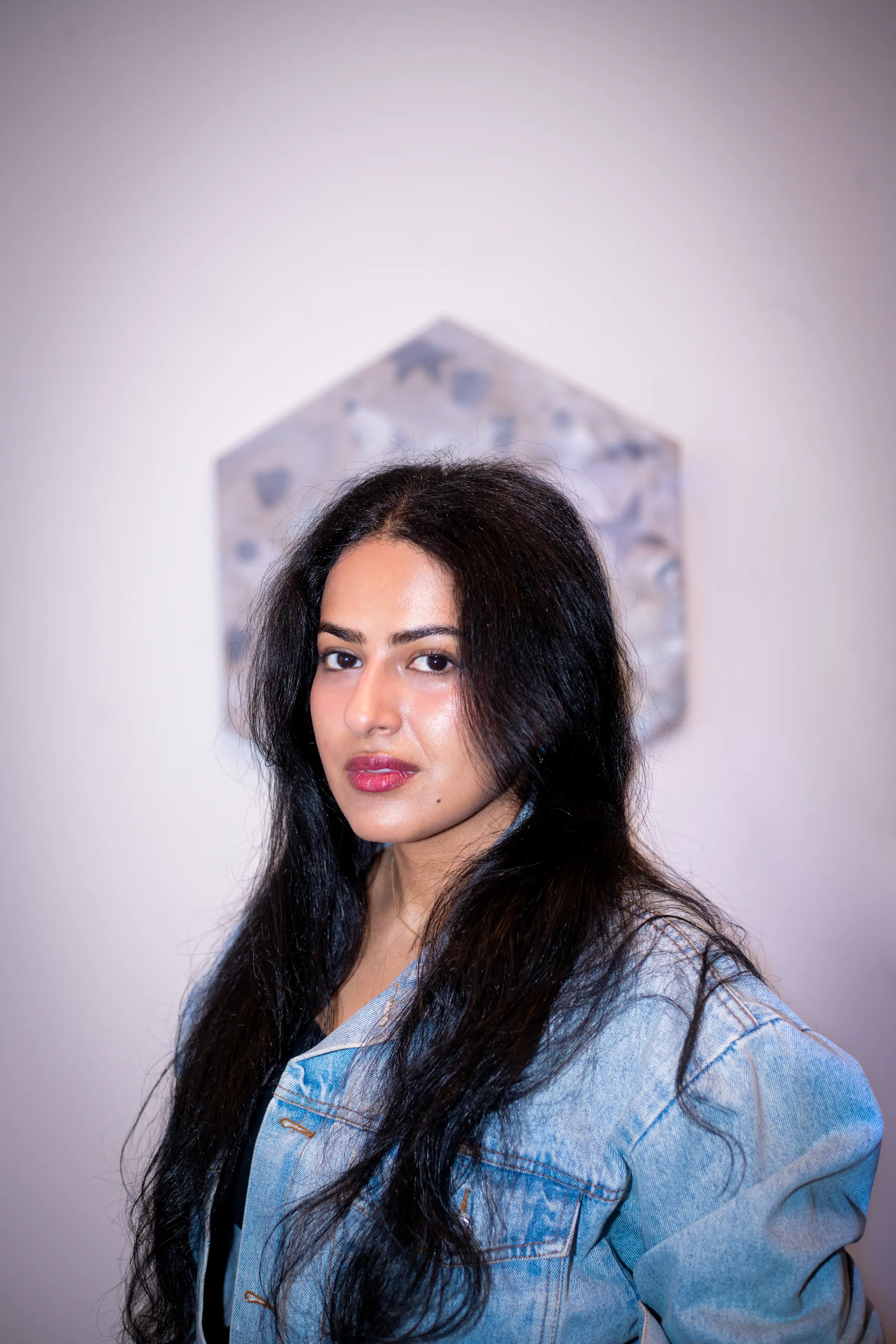
It’s Ramadan and Latifa Alajlan is exhausted, but continues to paint. She’s had a busy few weeks, with the opening of her latest show at Galerie Farah Fakhri in Côte d'Ivoire, alongside her second solo exhibition, “Along the way, something changed”, at Franklin Parrasch Gallery in New York, which opened earlier this month.
Her paintings exist as sites of negotiation, where structure and softness coexist, and where today’s political landscape is embedded without overt declaration. In speaking with Alajlan, it becomes clear that her work is not only about abstraction, but about abstraction as a lived methodology. In the new works on view, there is a sense that it is through this language that the artist shares personal reflections, moving through the world while absorbing and rearticulating meaning across contexts.
In her new show, a tension emerges between works that feel more animated than others. In some canvases, vibrant colors surface, with shapes that oscillate and expand across octagonal formats, while others are more muted, pared back to lighter compositions - showing off how dynamic yet poignant the work can be.
In this candid interview, the artist reflects on her evolving practice, what it means to be an Arab painter today, and how her upbringing between the States and Kuwait continues to shape her work.
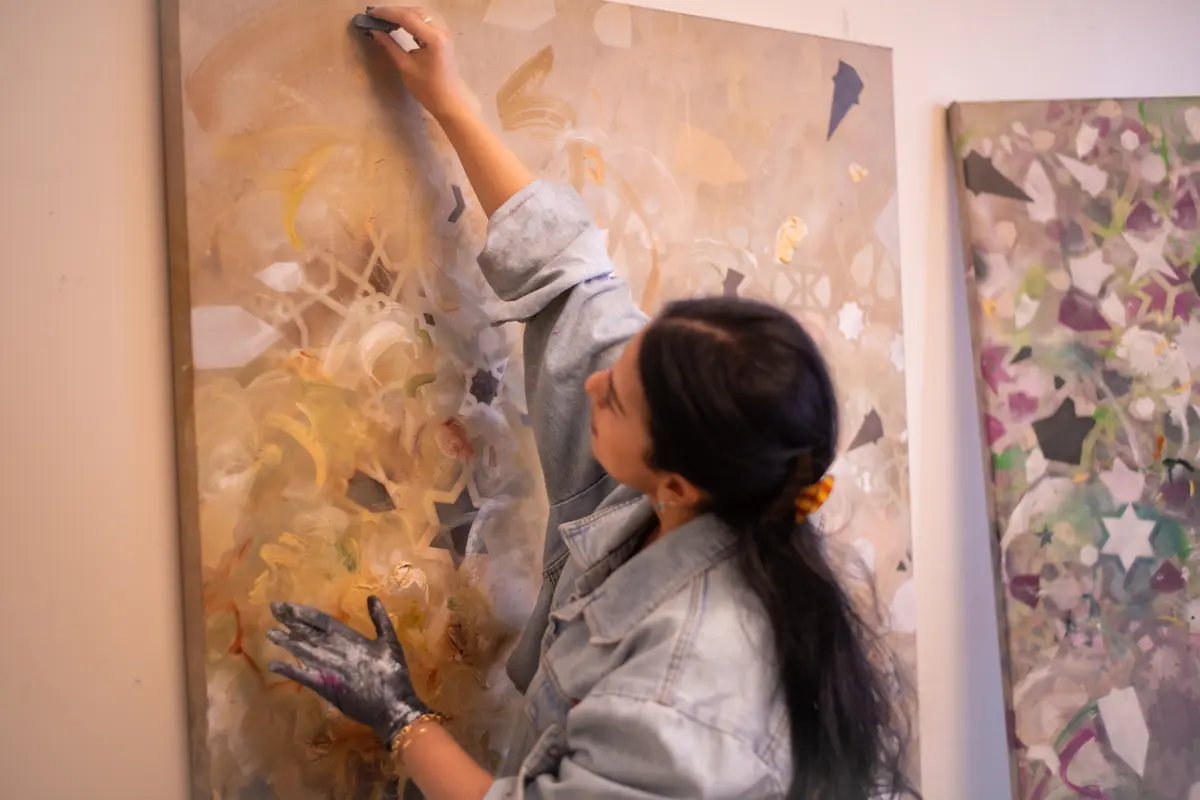
With you constantly moving between regions and cultural contexts, how has your experience with place and time shaped the way you think about space, structure, and belonging?
I see myself as a blender, constantly traveling and absorbing ideas, histories, and visual languages from different regions. Moving between places has shaped how I think about space and structure. I’m influenced by how environments are built, layered, and organized across cultures. Rather than belonging to one location, I see myself as a citizen of the world. This fluid relationship to place allows me to create work that isn’t fixed to a single context.
Outside of your home in Kuwait, are there particular cities or environments that sit beneath the surface of your visual language, even when they’re not explicitly referenced in dialogue or descriptions? Where have your most intense or affirming experiences happened in your art journey?
*Attending the School of the Art Institute of Chicago has been a major pillar in my practice. I would not be the artist I am today without my professors and the classes I took there. Being in an art school environment was foreign to me, especially growing up in Kuwait, where serious art education and critical discourse were limited. At SAIC, I immersed myself in art theory, read texts by major critics, and learned to think rigorously about my work. Visiting museums in Chicago felt like a child walking into a candy store, overwhelming, exciting, and deeply formative. It was there that I realized that the arts were not just an interest, but a space where I truly belong*.
You’ve presented your works on major platforms like Art Basel, which brings a different scale of visibility and that often forces, or helps, artist shift their perspective of self and their work. We agreed that fairs and festive activities are the perfect environments for us. Did these moments change how you relate to your own practice? Consider this question not only in terms of audience, but also how you situate yourself within a broader, global conversation around abstraction and contemporary painting?
Presenting my work at platforms like Art Basel expanded my awareness of where my practice sits within a broader global dialogue. Being surrounded by diverse approaches to abstraction and contemporary painting allowed me to see my work as part of an ongoing conversation rather than something isolated. I feel fortunate to have met artists from older generations who exhibit there and who have generously shared their experience and perspective, guiding me in thinking about longevity and commitment to the practice.
As a young Arab painter working in the United States, I am gradually finding my place within the New York art scene. Being here offers constant exposure to artists, institutions, and critical dialogue that continues to shape my growth. At the same time, this visibility allows my work to introduce audiences to a different cultural sensibility within abstraction, creating a space for exchange where both the artist and the viewer encounter something new.
Congrats on your recent recognition by Art Cube and representation announcements. This type of recognition suggests a new kind of institutional reading of your work. I’m curious what that acknowledgment meant to you internally, as an international artist in America, as a woman and abstract artist, did it feel like a confirmation of the direction you were already pursuing, or did it prompt you to reconsider how your work is being understood and positioned?
The recognition from Art Cube and the announcement of representation felt like both a quiet confirmation and a meaningful form of validation. Internally, it reassured me that the direction I was already committed to, focusing on structure, material, and the language of abstraction, was being understood and taken seriously. As an international artist working in the United States, this acknowledgment also felt like a sense of acceptance within the art world.
As an Arab artist, this recognition carries additional weight, as it is still rare to see Arab painters working within abstraction establish a presence in the U.S. context. Rather than changing my direction, it reinforced my commitment to the work itself and to continuing to build a practice that can exist confidently within a broader global conversation.
Your newest representation with Farah Fakhri, Arab woman gallerist, feels particularly resonant right now. Could you speak to what that decision represents for you culturally, professionally, and personally?
Working with Farah Fakhri feels meaningful on several levels. Culturally, there is a shared understanding that comes from working with an Arab woman gallerist of Ivorian Lebanese background, someone whose own identity moves between cultures. She is actively building bridges between communities, and that resonates with my practice, which is also shaped by movement, exchange, and layered cultural experiences. It creates a space where my background is understood as part of my perspective, without needing to be explained or reduced.
Professionally, the collaboration represents alignment in vision and long-term thinking about how the work should grow and be positioned. It is important for me to work with someone invested not only in visibility, but in building a practice with depth, care, and continuity.
On a personal level, it feels affirming to be part of a network of women from our region contributing to the art world in different roles. There is a sense of mutual support and shared responsibility to expand the presence of our voices within a broader global conversation.
What questions are you most interested in allowing the new body of work to hold?
In the new body of work, I’m most interested in questions around space. How it can feel constructed yet open, present yet elusive. Recently, my work has been focused on how space is formed through structure, layering, and intervals. How emptiness can hold as much weight as density. I’m exploring how spatial tension can create a sense of pause, movement, or quiet instability without becoming narrative.
I’m also thinking about how space can carry memory and cultural presence in subtle ways, where shifts in scale, rhythm, and material suggest something felt rather than described. The work is becoming more sensitive to how forms breathe, separate, and relate, allowing space itself to become an active element rather than just a background.