
Faith Ringgold’s Knack for Storytelling Still Holds Strong at Jack Shainman
.webp)
When I was younger, I constantly reached for Tar Beach each night. I loved snuggling on the couch with my mom, waiting for her to serenade me with the magical story spun by Faith Ringgold. Even today, whenever a close friend has a baby, you can count on me to gift the seminal book for a new generation to enjoy.
That sense of wonder and repetition, of returning again and again to Ringgold’s world, came rushing back while visiting Jack Shainman’s Lafayette St gallery inaugural mini-retrospective, Faith Ringgold. The exhibition makes clear how Ringgold’s work continues to balance imagination, history, and political urgency with remarkable force. Bright colors, weavings, tapestries, and quilts fill the gallery, underscoring the depth and range of the artist’s immense career. Speaking with curator Anna Model, who organized the exhibition, she shared the gallery’s long-term commitment to presenting Ringgold’s work with the “depth, care, and historical rigor her practice demands,” further cementing her with other great American artists.
It is easy to get lost in the intricate details of the tapestries, as if being transported directly into the scene of Jazz Stories: Mama Can Sing, Papa Can Blow #2: Come On, Dance With Me. The rhythm of the dancers and the band seems to jump from the frame, allowing the viewer not just to see the music, but to feel movement of the dancer’s hips as she sings to the rhythm of the bass.
While Ringgold’s kaleidoscope of colors often feels dreamlike to me, as if I am Cassie from Tar Beach, soaring above the city, I am reminded that each work is built from layers of storytelling and history. This becomes especially clear when confronted with Atlanta Children, whose message remains devastatingly relevant. Representing Ringgold’s sculptural practice, the work features small mummified children, each adorned with name tags and photographs of the children murdered in Atlanta during the 1970s and 1980s. Pins bearing words allude to lives lost too soon, urging us to save our children.
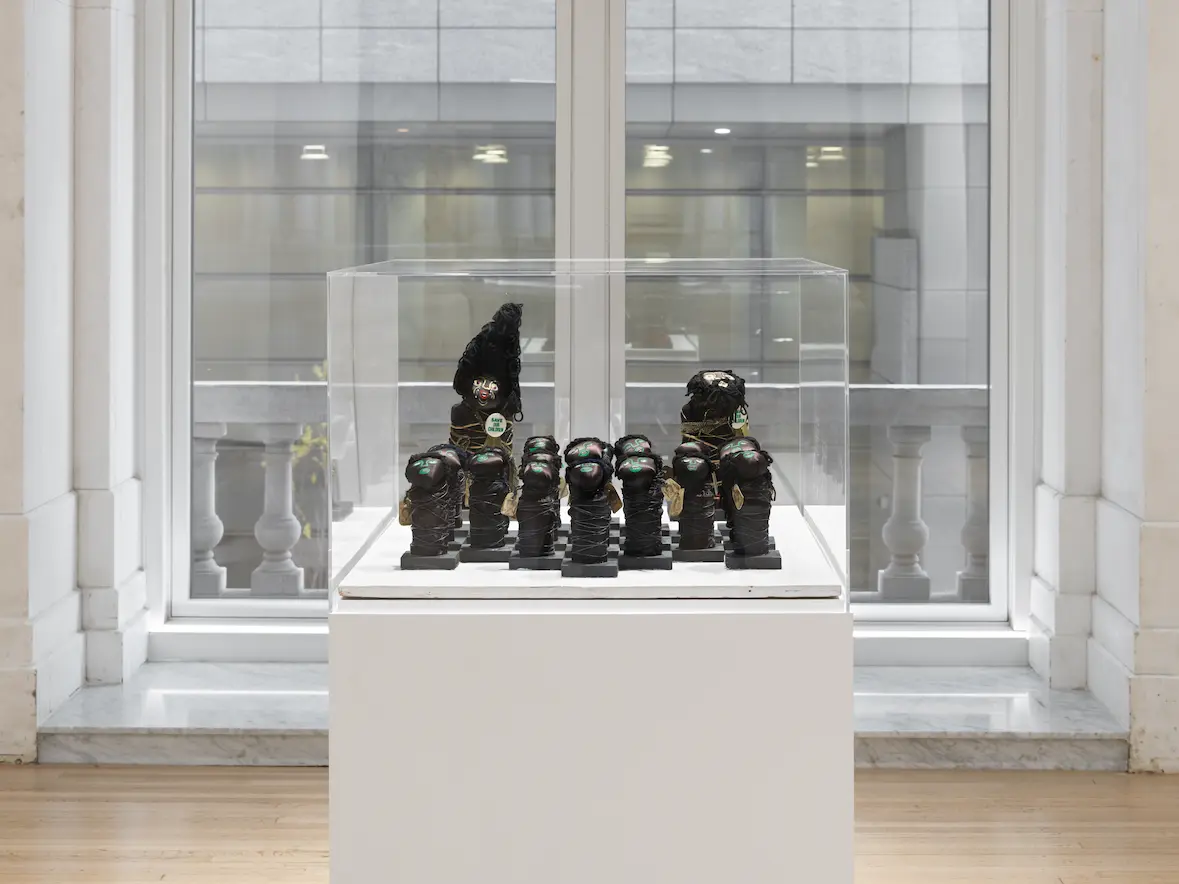
Faith Ringgold, Atlanta Children, 1981. Mixed media on painted board. Courtesy Anyone Can Fly Foundation and Jack Shainman Gallery, New York.
Reflecting on the work’s significance, Model notes that the piece “remains eerily resonant today,” particularly given the gallery’s proximity to 26 Federal Plaza, where scenes of state violence and the unlawful detention of migrants unfold daily. “There are few more powerful ways,” she adds, “to underscore the enduring insistence of Faith’s work to respond directly to the urgencies of the moment.” Standing in the middle of the gallery, I pause, thinking of all the children dreaming of full lives while being held back by a country’s ignorance.
Sometimes, I like to think that reading Tar Beach as a child was formative in my desire to be immersed in the art world, or perhaps I simply clung to the freedom and magic Cassie imagined. Ringgold’s gift for storytelling continues to transport me to places I could never have envisioned on my own. Long after leaving the exhibition, I am left wondering how many others her work has shaped, and hopeful that this new chapter at Jack Shainman Gallery will set the tone for how her legacy is understood, now and for generations to come.