
“Not Heroic Nostalgia but Continuity:” Four Artists Call Forth Guatemala at Bergen Community College
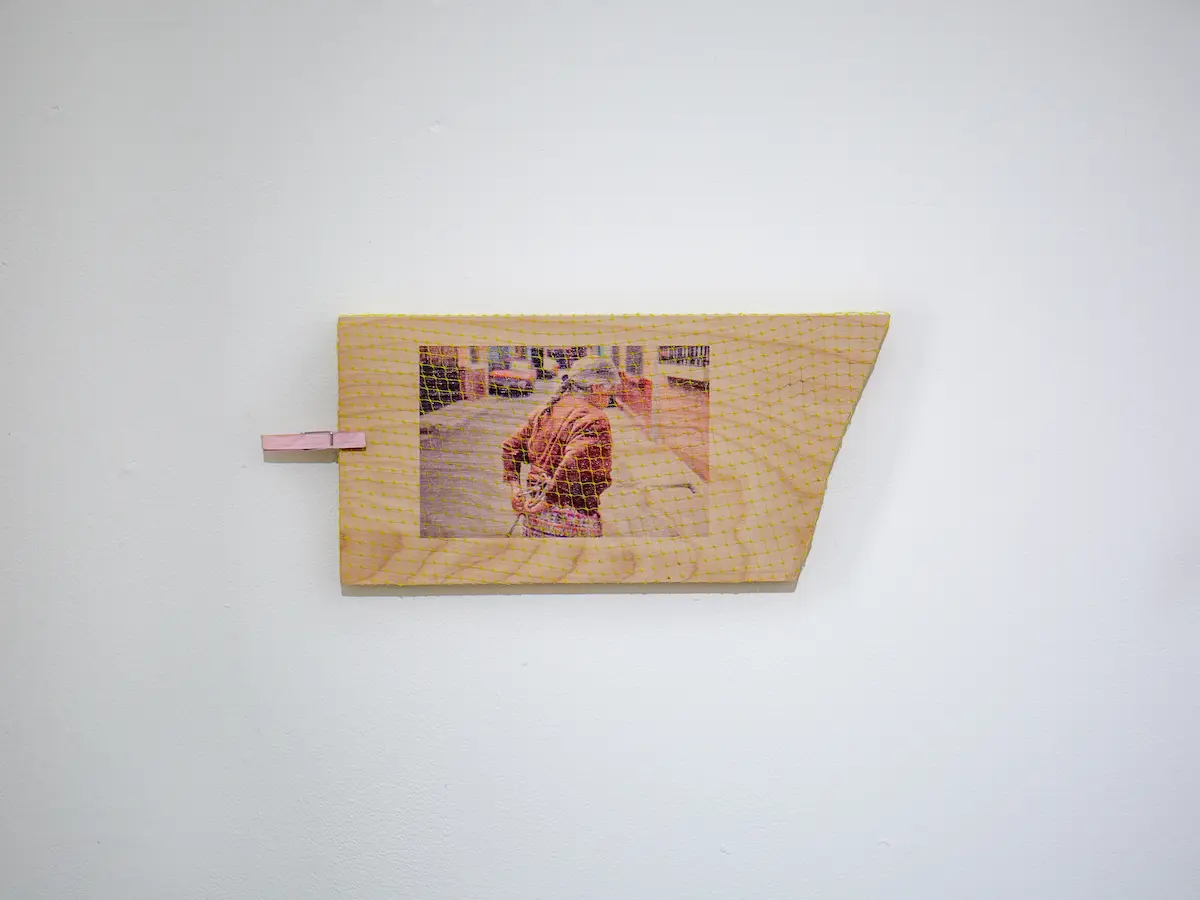
Nivia Hernandez, She whistles before the birds wake up to sing/Ella silba antes de que los pájaros se levanten para cantar, 2025. Produce bag netting, uv print on wood, wooden clip, house paint, 5 in x 11 1⁄2 in. Courtesy of Gallery Bergen.
Late last year, four Guatemalan artists came together in an exhibition to benefit the humanitarian organization Grupo Cajolá, currently on view at Bergen Community College’s gallery space in Paramus, New Jersey, through February 5, 2026. A video projected on one gallery wall shares the story of how Grupo Cajolá’s mission crystallized: in 2006, a group of New Jersey-based immigrants from Cajolá returned there to foster educational and professional opportunities centered around Maya Mam culture. From founding weaving cooperatives to implementing experiential learning based in the Mam language in preschools, Grupo Cajolá has successfully developed the community in Guatemala to make migration less of a necessity for its residents to escape poverty. In Telas de Solidaridad/Threads of Solidarity: Connections to Guatemala, the contemporary artists on display—most based in the United States, and working across oil painting, watercolor, ceramics, and assemblage—accompany Grupo Cajolá’s message by recalling Guatemala with a spirit of tenderness and vitality. The exhibition was organized by Grupo Cajolá’s Executive Director Caryn Maxim and Board Vice President Diana Crowder, in collaboration with Gallery Bergen’s director Tim Blunk.
In Greek literature, returning to a civilized home by sea was the last accomplishment in an epic hero’s journey. Nostos, the Ancient Greek term used to refer to the homecoming, was involved along with the root -algos—meaning pain—in the coinage of the term denoting the psychological illness of longing for the past. Nivia Hernandez’s sculptures are not nostalgic in that they express pain or gesture towards an inaccessible history; they serve to document her yearly tradition of returning to her birthplace of Guatemala City. Hernandez began this homecoming ritual in 2011, her first time traveling to Guatemala since migrating to New York with her mother and sisters as an infant in 1991. Upon her return, she found community among local women and children, who became the subjects of photographs she began to incorporate within her careful assemblies of found materials.
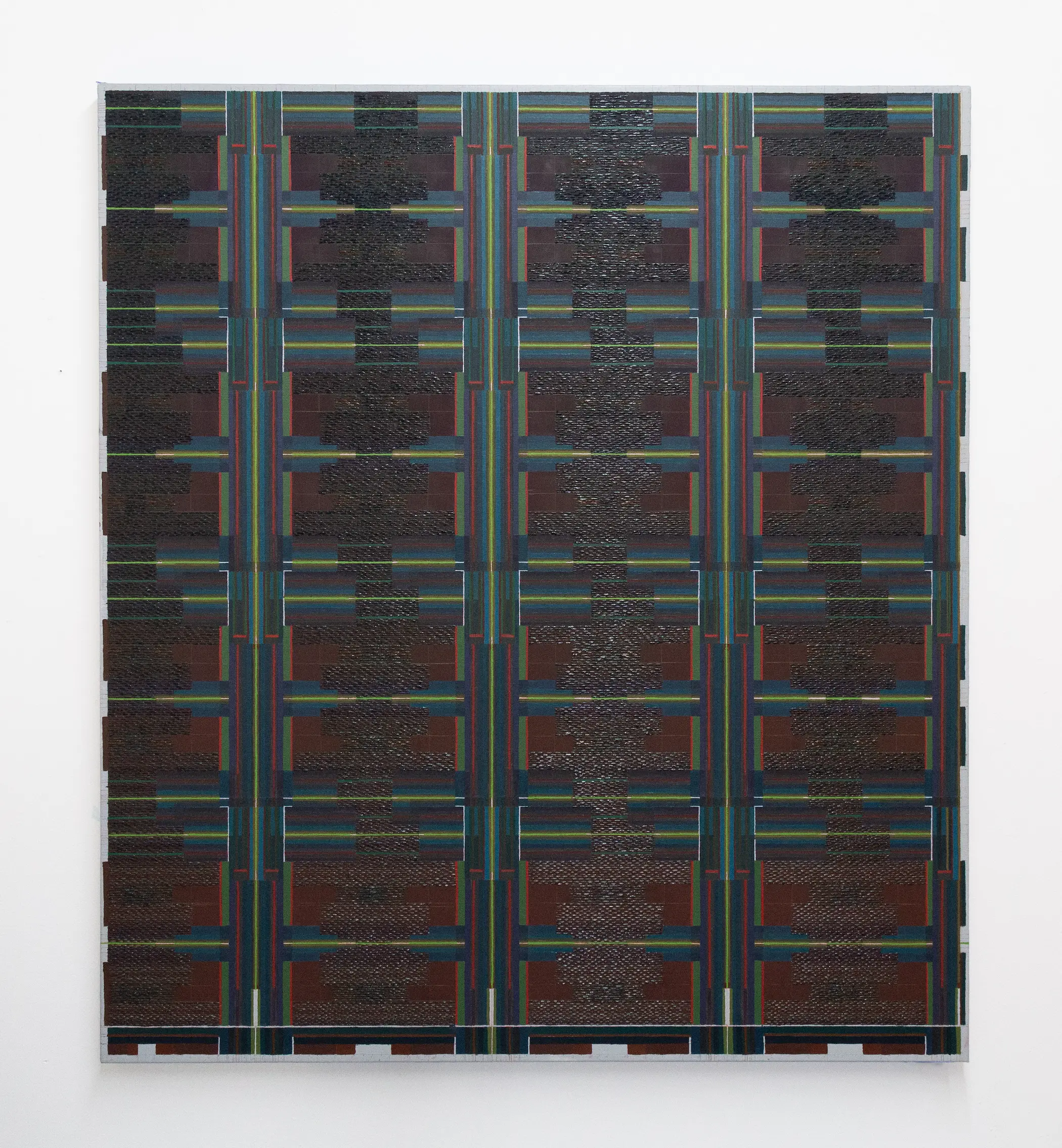
Luis Emilio Romero, Almas Flotantes, 2025. Oil on canvas, 56 in x 48 in. Courtesy of Gallery Bergen.
Two such works are presented as a diptych in Telas de Solidaridad, both consisting of one UV print on a small wood panel which each depict a different woman with her back turned and face angled away from the viewer. Stretched across the wood panels and the images they contain are fragile netted veils: in She whistles before the birds wake up to sing, this was sourced from a produce bag. Hernandez often uses inexpensive, domestic materials for her sculptures, and she often obscures the faces of her subjects when incorporating their photographs. This is not to abstract them from the viewer so much as to hold them—the slack yellow mesh here also comes across as a dreamlike-haze of remembering a place, a person, and a moment.
If Hernandez works primarily in the pearlescent, pastel palette of a sunrise, Luis Emilio Romero’s adjacent oil paintings capture the umbers and indigoes of dusk. The New Jersey-raised painter’s early work modeled its structures from Indigenous Guatemalan textiles, but now their mazelike gridded surfaces have taken on a life of their own. Standing at a distance from the paintings still might fool a viewer into seeing plaid fabric, but looking for longer, the tesselate designs may invoke more mysterious architectural structures, what Romero himself refers to as “fortresses,” or even the intricate byways of a circuitboard. What remains important across Romero’s practice are principles of luminosity and tactility, achieved by thicker, stitch-like brushstrokes of oil paint that catch light and create a subtle gradient sheen across partitioned segments of the paintings. Hand-drawn lines and carefully-chosen palettes charge the work with interconnected systems of light and dark.
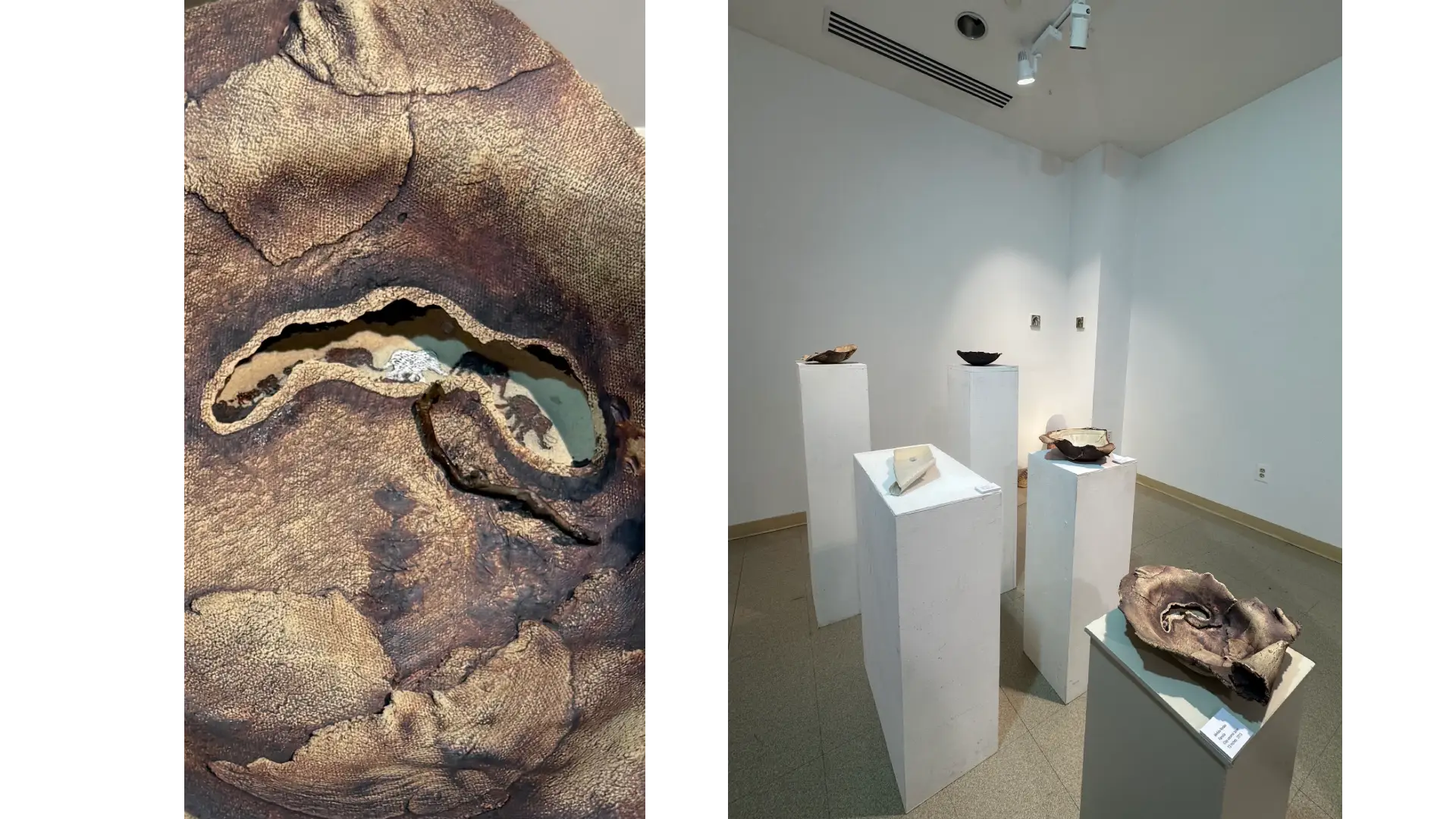
Detail and installation view of Melida Rodas’ elefante ceramics. Courtesy of the artist.
Across the large gallery, Juan Carlos Vail takes on painterly abstraction in more organic forms, wrought in lurid watercolor. Like Romero’s, Vail’s paintings—which involve surrealist composites of shapes resembling balloons, eyes, and tendrils—become more complex the longer one looks, accruing their own strange and sensuous logic. An award-winning artist in Guatemala, resident of Quetzaltenango and a volunteer with Grupo Cajolá who teaches art to the fourth grade and higher, Vail was notably absent from the exhibition’s opening ceremony after being denied a visa to enter the United States.
Melida Rodas, poet laureate of Jersey City, completes the exhibition with a project that addresses complex injustices surrounding migration through the elephant—a symbolic figure that ties together her work on view across video, text, collage, and a collection of delicate ceramic masks and vessels displayed like archaeological treasures. “These masks are not disguises meant to deceive, but shelters—ways of hiding from captors rather than blending into them. By adopting animal forms, faces refuse legibility. They echo ancient survival strategies and mythic lineages,” she writes in a statement on display in one vitrine. “The reference is not heroic nostalgia but continuity—identity passed through material, gesture, and surface. Migrants appear as elephants in search of water and shelter and safety: collectively moving as in caravans, softened, and entangled by systems of movement and control.” Telas de Solidaridad comes across as an appropriate celebration of movement—both material and emotional—between one home and another, a conviction central to the work of organizations like Grupo Cajolá. Together, its artists demonstrate a resolute sense of belonging that spans across more places than one. Proceeds of the work on sale in Telas de Solidaridad will be donated benefit Grupo Cajolá’s community work.